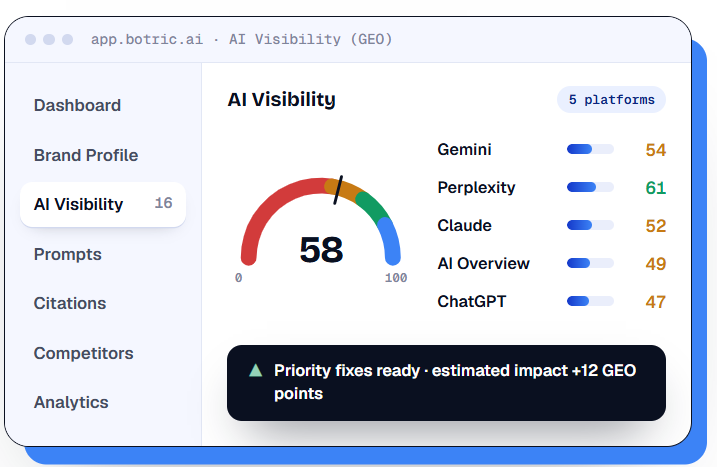
Why brands get missed in AI answers
Most companies still optimize for traditional SEO signals, assuming that visibility in search results automatically translates to visibility inside AI answers. But modern AI experiences often synthesize information from a narrower set of sources, then choose citations based on perceived authority and consistency. When your name, products, AI Visibility Platform or thought leadership aren’t clearly linked across the web, AI systems may omit you even if you rank well on classic search queries. The result is a quiet discovery gap where customers see competitors referenced repeatedly while you remain absent.
Another common issue is inconsistent entity representation. If your brand name appears with multiple variants, outdated product terminology, or mismatched domain-to-brand mappings, AI models have a harder time determining what “you” refers to. Many organizations also publish content without measuring how it performs in AI-generated citations, so they don’t learn which pages actually get referenced. Without feedback from AI answer ecosystems, marketing teams can only guess whether their content is being surfaced by ChatGPT-style assistants, AI Overviews, or other large models.
What an AI visibility tracker should measure
An effective approach starts with measuring AI brand visibility in the channels where customers make decisions. Mentions show awareness, while citations indicate reliance—both matter, but citations often correlate more directly with trust and conversion. A measurement system that distinguishes the two helps you prioritize the work that moves the needle.
You also need coverage that reflects real user journeys, not just a single prompt template. People ask about solutions in many phrasing patterns—by problem type, industry, comparisons, or feature requirements—so the tracker should evaluate visibility across varied intents. In addition, the ability to segment by product line, topic cluster, or target audience makes the results actionable for marketing and product teams. When visibility data is organized in a way that maps to your strategy, you can move from “we’re being mentioned” to “we’re winning in these scenarios and missing in those.”
Turning visibility data into a practical solution
The biggest advantage of tracking is that it converts uncertainty into a repeatable improvement loop. Once you know where you are mentioned or cited, you can audit the content and digital signals that likely drive those references. For example, if you notice frequent mentions around compliance topics but weak citations on pricing comparisons, you can publish clearer cost frameworks, downloadable calculators, or decision guides. The goal is not to add more content blindly, but to align your assets with the specific questions AI systems are selecting sources for.
Visibility gains also come from strengthening how your brand is understood as an entity. That can include standardizing brand naming across web properties, ensuring product pages are indexable and internally linked, and maintaining consistent structured information where appropriate. When AI systems can confidently connect your company name to the right web pages and claims, they have less reason to avoid citing you. Over time, consistent signals help you become a stable reference point, so your brand appears more reliably across different AI platforms and user prompts.
Use cases for teams: marketing, PR, and product
Marketing teams can use an AI visibility tracker to validate content strategy with a new metric: citation frequency in AI answers. Instead of relying solely on traffic and rankings, you can measure how often your campaigns influence AI-generated recommendations. If a thought leadership article earns strong citations, you can repurpose it into comparison pages, FAQs, and onboarding resources that better match high-intent queries. If another piece generates mentions without citations, you can refine the evidence, add source-backed details, and improve how key claims are presented.
For PR and executive communications, AI visibility provides a way to measure whether coverage turns into reusable references. When journalists, analysts, or partners mention your brand, AI systems may later cite those same ideas when users ask related questions. Tracking helps you identify which themes travel through AI ecosystems and which don’t, allowing you to adjust messaging and distribution. Product teams benefit too: visibility gaps often reveal confusion about features, positioning, or integrations, which you can address with clearer documentation and more direct answers to common use cases.
Conclusion
AI discovery is increasingly shaped by citations and references, not just keyword matching. If your brand isn’t consistently mentioned and cited across major AI experiences, customers can’t find you through AI-assisted search behaviors, even when you’re active online. A purpose-built AI visibility tracker helps you identify exactly where the gaps are and which platforms are driving the mismatch between awareness and trust. When you connect measurement to content, entity clarity, and distribution, you turn visibility from a hope into a system. By focusing on mentions and citations across ChatGPT-style answers, AI Overviews, and other leading models, you gain direction for practical improvements. That shift—from guessing to learning—creates a durable path to stronger brand presence in AI-driven decision moments.